Crypto & Stablecoins
Run Business Money in USDC or USDT? | Elephants Inc.
See how a stablecoin payments platform supports a hybrid business-money workflow: settlement, tax, regulation, and practical USDC and USDT use cases.

Stablecoin Business Payments: Which Payments Should Use USDC or USDT?
In a single week, you might pay a supplier in another time zone, invoice a client who bills in a different currency, and settle a local cost at home. Each payment has its own recipient, currency, and deadline. The right way to move the money will depend on the payment.
For founders considering stablecoins for business payments, the useful question is not whether they should replace their existing payment methods. It is which option creates the least friction for the payment in front of you.
At Elephants Inc., we do not think you should have to choose one way to move business money. What helps is having supported fiat and stablecoin options in one place, so you can choose the payment option that fits each transaction and see it all in one intelligent system.
The stablecoins category is no longer marginal. In July 2026, the Federal Reserve Bank of New York estimated the market capitalization of U.S. dollar stablecoins at about $308 billion, with USDT and USDC accounting for more than 80% of the industry’s assets. Scale does not make stablecoins right for every payment, but it does make the operating question worth answering.
This guide explains when USDC and USDT help, when another payment option is the better call, and what to look for in a stablecoin payments platform if you decide to use one.
Where USDC and USDT Can Help, and Their Limitations
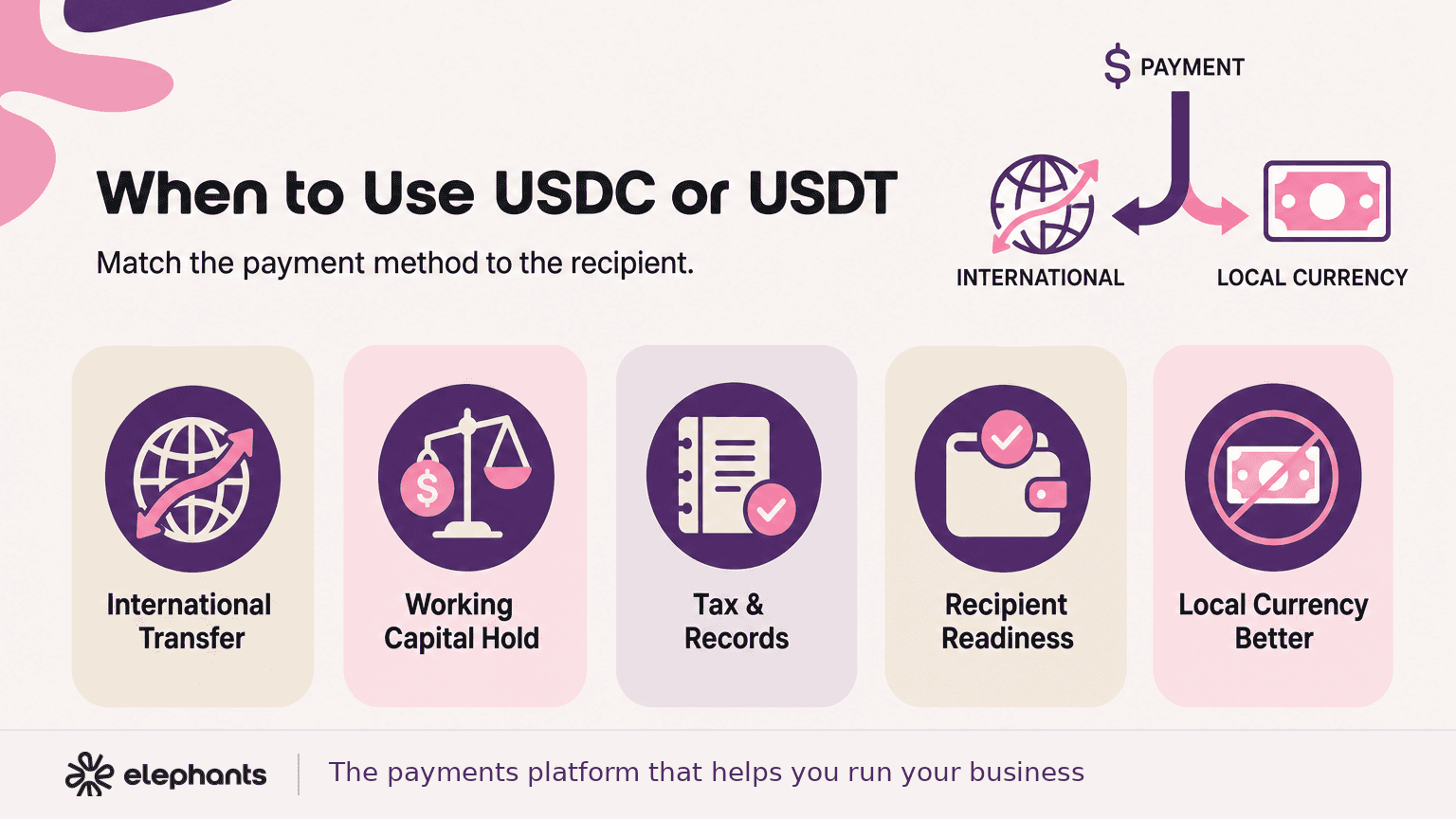
The clearest use case is an international payment to a supplier or service provider who can receive the asset and network you plan to use. Stablecoins give you another way to move dollar-linked value across borders without adding handoffs to the payment. The same applies to a working-capital flow: receive USDC or USDT from an international client, hold the balance while you arrange the onward payment, then pay out in local currency when the recipient needs it.
Timing is one reason the way you pay matters. ACH transfers typically clear in one to two business days, while wire timing can depend on bank cutoff times, weekends, and holidays. A stablecoin payment can help when those windows create friction, since stablecoin networks operate around the clock, though delivery still depends on network, compliance and platform processing.
Use stablecoins when they fit the recipient and the payment, not simply because they are available. If the recipient needs local currency in a local account, or the payment may require correction, dispute handling, or an established local process, a conventional option is usually the better choice.
If you plan to hold working capital rather than move it straight through, check the wallet arrangement first: who controls access, the applicable terms, and the protections attached to the balance. Funds held in a wallet balance are not bank deposits and are not insured by the Canada Deposit Insurance Corporation or another deposit-protection scheme. Review the applicable terms before deciding what role stablecoins should play in your working capital.
Tax, Accounting, and Local Availability
Two things tend to catch founders out once stablecoin volume picks up: how these payments are taxed and where they are available. Neither is complicated, but both are easier to handle before the volume arrives than after.
Here is what to check:
Treat them as property, not currency, for U.S. tax. The IRS includes stablecoins in its definition of digital assets and treats them as property for federal tax purposes. Transactions may need to be reported even when they produce no gain or loss.
Agree the records with your accountant now. Ask a qualified tax adviser which records your business needs to keep, and make sure your bookkeeping can produce them without a manual reconstruction at year-end.
Confirm availability where your counterparties are. In the EU, MiCA affects which stablecoins service providers may offer, so check current availability before standardizing on USDC or USDT with European clients. Elsewhere, check the requirements that apply to your role and the transaction.
Choosing Between USDC and USDT
Choosing between USDC and USDT is an operational decision, not a verdict on which asset is better. Start with what the other party can receive and what your account supports. For Elephants accounts, USDT is supported on Ethereum, while USDC is supported on Ethereum and Solana. If both work, choose the one that creates the fewest conversions and handoffs. Confirm the asset and network before sending.
The table below summarizes the differences worth weighing before you decide how to send the payment.
Factor | ** USDC** | ** USDT** | ** Conventional method** |
|---|---|---|---|
Supported through Elephants | Ethereum or Solana | Ethereum | Local payment methods or SWIFT |
Payment finality | Non-reversible once sent | Non-reversible once sent | Correction or dispute options vary |
US tax classification | Digital asset; property | Digital asset; property | Fiat currency |
Deposit protection | Not a bank deposit | Not a bank deposit | Not a bank deposit when held with Elephants Inc. |
Sources: Elephants FAQs for supported assets, networks, and transaction finality; IRS digital asset guidance for U.S. tax treatment; and J.P. Morgan Payments for ACH and wire timing.
How Elephants Helps You Manage Different Ways to Pay
Business money does not always move the same way, and using a different tool for each payment is where the manual work begins. Elephants brings fiat and supported stablecoins into one place, giving you a clearer view of what is coming in, what is going out, and which payment option fits each transaction.
Elephants wallets can hold and receive USDC and USDT, as well as major currencies such as USD, EUR, GBP, HKD, and SGD, with more planned over time. That means you can hold incoming payments, see all balances together, and decide how to use each payment without switching between systems.
Getting paid starts with a request, not a set of manual instructions. Sending a payment request or stablecoin invoice gives your client a straightforward way to pay while keeping the payment connected to the business workflow. Each Elephants invoice includes a wallet address and a QR code for stablecoin payment, so the funds can land directly in the same wallet you already use to spend, transfer, and run your business.
When it is time to pay out, match the payment method to what the recipient can actually receive, rather than forcing every payment into a single format. Elephants supports transfers in more than 100 currencies through local payment methods and SWIFT, as well as USDC or USDT transfers to any wallet that accepts them on a supported network. Because stablecoin transfers can move around the clock, subject to network, compliance and platform processing, a payment does not have to wait for conventional processing hours, though availability does not guarantee when the recipient can use the funds.
You also see the cost before you commit. The transfer review screen shows applicable fees and any currency conversion before confirmation. Your team can prepare payments while owners and admins retain approval control, so speed does not come at the expense of oversight.
A Practical Checklist Before You Use Stablecoins
Before changing how your business handles cross-border payments, work through one payment from start to finish. A payment option is only useful if it fits the recipient, your records, and your wider operating process.
Set the payment scope. Start with a single supplier or client flow that has a real cross-border problem, rather than moving all your operating funds at once.
Confirm recipient readiness. Make sure the recipient can receive the stablecoin on the network you plan to use.
Choose how to send the payment. Consider whether the recipient needs stablecoins or local currency, and whether local payment methods or SWIFT are better suited to the destination.
Review costs before sending. Check the displayed network fee, Elephants’ fee, and any currency conversion before confirming the transfer.
Plan your records. Make sure your accounting process can document receipts, spending, conversions, and transfers between your wallets.
Review local requirements. Payment obligations can differ by jurisdiction, transaction type, and your role in the payment.
Match the format to the recipient. If someone needs local currency for day-to-day expenses, use the payment option that meets that need rather than defaulting to stablecoins.
Frequently Asked Questions
Can you receive USDC or USDT through Elephants?
Yes, if the sender uses an asset and network supported by your Elephants account.
Can you pay your team in stablecoins?
Elephants supports team payments in fiat, stablecoins, or both, depending on what suits the recipient. Elephants facilitates fund transfers only and is not a payroll or employer-of-record service. Your business remains responsible for employment and tax obligations.
Who should help with tax and local payment requirements?
Ask a qualified tax adviser about recordkeeping and the treatment of spending or converting stablecoins. For local payment requirements, seek advice covering the jurisdictions relevant to your business and how you plan to send the payment.
Do conventional payment methods still have a role?
Yes. Conventional payment methods remain useful for local collections, for familiar payment instructions, and for payments that may require correction or dispute handling. The point is not to choose one way to pay for everything, but to manage fiat and stablecoin options together and use the one that fits the payment at hand.
Ready to Manage Business Payments in One Place?
Your business will use more than one way to move money. Elephants brings fiat and supported stablecoins into one place, so you can choose the right option for each payment. Get started with Elephants.
Eligibility applies. Multi-currency is available to verified business accounts, subject to review. Eligibility depends on your country of registration and industry, and varies by account, by currency, and by payment network.
Elephants facilitates the transfer of funds only. Tax withholding, pension and provident fund contributions, superannuation, social security, and all other statutory employment obligations remain your responsibility as the employer.
Regulatory information
Elephants Inc. is a fintech payments platform registered in Canada as a Money Services Business and Payment Service Provider. Elephants Inc. is powered by Elephants Growth Tech Ltd, which is registered with FINTRAC as an MSB (Registration No. C10001690) and with the Bank of Canada as a PSP under the Retail Payment Activities Act. You can verify this registration on the Bank of Canada's public PSP registry: https://www.bankofcanada.ca/regulatory-oversight/retail-payments/psp-registry/.
This enables Elephants to support foreign exchange, money transfer, virtual currency services, payment accounts, fund holding, and electronic fund transfers for end users.
Read More


