Cross-Border Finance
Cross-Border Payments With a Multi-Currency Account | Elephants Inc.
Understand what actually differs between cross-border providers: settlement speed, fees, currencies, compliance, and workflow capabilities.

How to Run Cross-Border Payments With a Multi-Currency Virtual Account
A supplier abroad is waiting on this week’s payment. An overseas client has just paid an invoice. A contractor is asking why last month’s transfer arrived short. None of these is complicated on its own. What makes the week hard is that each one runs through a different provider, on a different timeline, with charges you only see after the money has gone.
That is usually what sends a founder looking for a multi-currency virtual account: not simply a better transfer, but a way to run cross-border payments without scattering money, approvals, records, and spending across different tools. At Elephants Inc., we built around that reality: keeping more of the work around business money in one place.
Start with the work your business actually needs to do. Who do you pay? Where are they? Which currencies do you receive, hold, and send? And how much of the work around each payment can your team manage in one place?
Start With How Your Business Actually Moves Money
Two providers can both promise international transfers, broad currency coverage, and competitive fees, yet leave your team with very different workloads. The useful comparison is not just what each provider can send. It is how much of the payment process your team can manage without stitching together more tools.
That is the practical comparison: not which provider has the longest feature list, but which setup makes the work around your money easier to run.
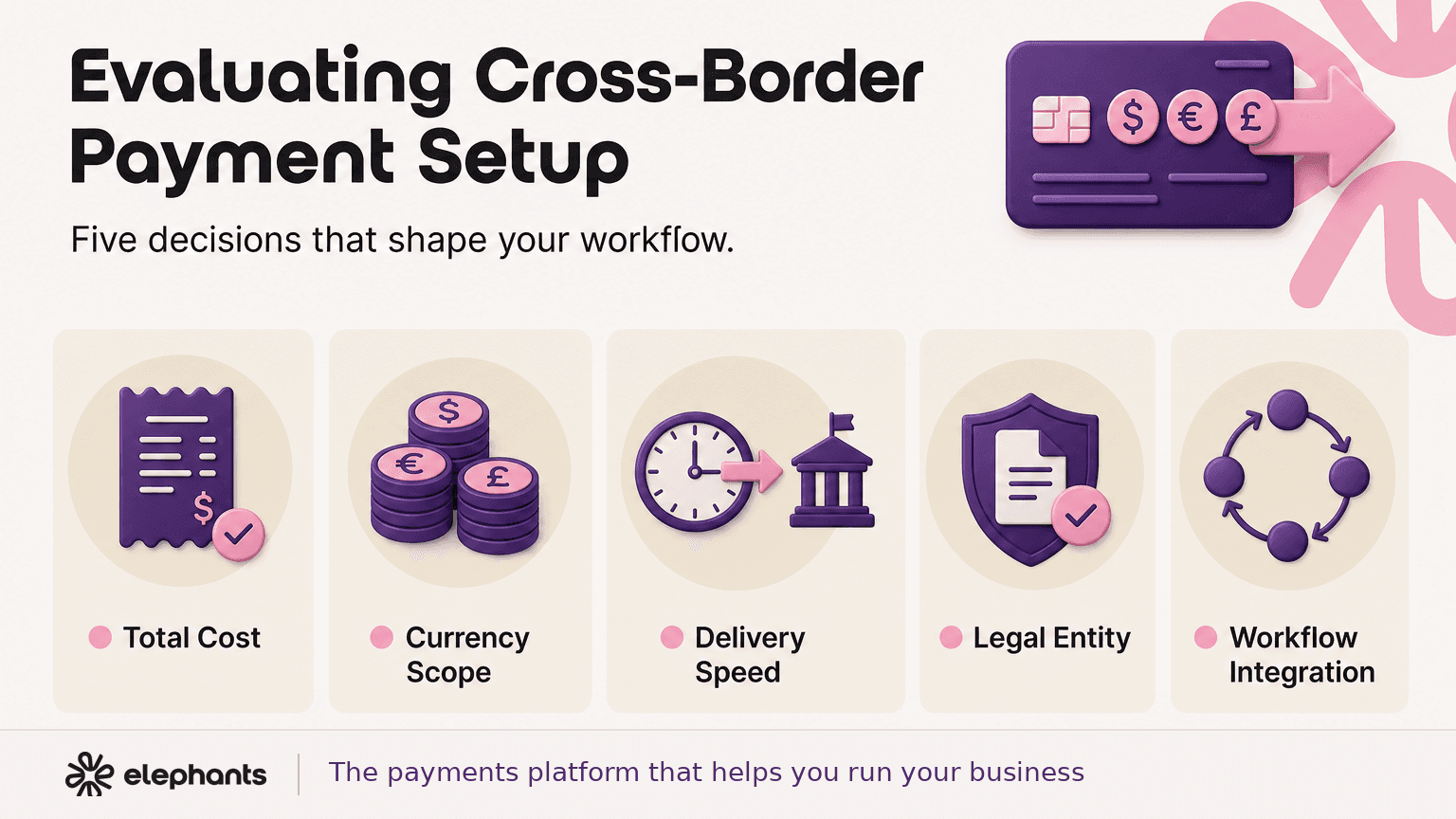
Use this checklist to evaluate what to consider when you’resetting up your multicurrency setup:
Total quoted cost. What leaves your account, what does the recipient receive, and which conversion costs appear before you authorize the transfer?
Currency capability. Can you send the currencies you need? Can you also hold and receive the currencies used by your customers, partners, or suppliers?
How you send. How long does delivery take for the payment flows you actually use, including around cutoffs, weekends, and public holidays?
Who is behind the payment? Which legal entity moves your money, and which authority covers that activity?
Workflow fit. Can your team submit, approve, track, reconcile, and manage related spending without moving among disconnected tools?
You may not need every capability. If you pay a few overseas suppliers, your setup will look different from one that also collects funds, manages card spend, and sends regular contractor payouts. The right setup depends on how your business actually receives, sends, and spends money.
Compare Total Cost and Currency Capability
For cross-border B2B payments, a headline transfer fee is only one part of the comparison. The full quote should show how much you send, how much the recipient receives, any network charges, and the conversion applied before you approve.
An FX spread, the extra cost built into an exchange rate, can matter more than a low fixed fee on a larger payment. A simple illustration shows why the complete quote matters more than one advertised number:
Example | Fee structure | Total Cost on $10,000 |
|---|---|---|
A | $5 fixed fee + 3% conversion cost | $305 |
B | $15 fixed fee + 0.5% conversion cost | $65 |
For context, the Financial Stability Board's 2025 progress report on the G20 cross-border payments roadmap puts the global average cost of sending a USD 200 remittance at 6.5%[1], while the average cost of a business-to-business cross-border payment for a small or mid-sized company is 1.6%[1]. Remittance pricing is not what most businesses pay, and that gap is the point: cost varies sharply by payment type and corridor, and 18.3% of corridors still cost more than 3% of the amount sent[1]. The full quote matters more than any single advertised number.
Use the recipient amount as a practical check. If your supplier expects a particular amount, confirm whether fees are deducted before delivery or included in the amount shown before confirmation. If you use a market rate as a reference, compare it with the conversion in the quote, then decide based on the total cost to your business.
Currency language deserves the same scrutiny. In a multi-currency account, "multi-currency" may refer only to the currencies you can send in, or it may also include separate balances for holding and receiving funds. Those are different capabilities.
For each provider, establish whether you can receive a currency into an account or wallet, or only convert and send it. Holding and receiving funds can give you more control over when you convert.
Ask: How Long Will My Supplier Actually Wait?
Timing matters most when another person is waiting on the money. Ask how long your supplier, contractor, or partner is likely to wait for the countries, currencies, and payment methods you actually use.
The answer can vary depending on the destination, receiving bank, payment method, cut-off times, weekends, and public holidays. A fast transfer in one market does not guarantee the same result elsewhere.
If timing is critical, test that payment flow before making it central to your operation. What matters is the experience your business and recipient will actually have, not a provider's fastest headline.
Timing is only one part of the decision. You also need to know who is responsible for moving the money.
Verify the Provider Behind the Payment
Knowing who moves your money matters beyond compliance. It helps you understand which legal entity is responsible for moving your money, where you can use the service, and who you will deal with if an issue needs to be resolved.
Keep this part simple. Identify the legal entity providing the payment service, the authority covering its money-movement activity, and the jurisdictions that activity supports. Then verify the answer through the relevant regulator or official register where available.
You do not need a jurisdiction-by-jurisdiction licensing directory to make a sound comparison. You do need a clear answer connecting the provider's name, operating entity, and payment activity. If that answer is vague, or if the entity named in the terms does not match the entity described in the provider's materials, pause before moving funds.
This check belongs alongside cost and timing. Your payment setup needs to fit the countries, currencies, and workflow involved, and it should be clear who provides the service to your business.
Skipping this check has a cost, even if nothing goes wrong at first. If you cannot name the entity behind your payment, you also cannot say who to contact if a transfer stalls, which regulator you would escalate to, or how your funds are held while they sit with the provider. These questions tend to surface anyway, often from your own bank or an investor during diligence, so it is worth answering them upfront rather than under pressure later.
Map the Workflow Around the Transfer
A transfer is rarely just a transfer. Before it is executed, your team may need to receive an invoice, enter payment details, submit an instruction, and obtain approval. Afterward, someone may need to confirm delivery, match the payment to the records, answer a supplier's question, or understand the available spend.
That is where disconnected tools create more work. Your transfer may happen in one place, your invoices in another, your cards somewhere else, and reconciliation in a spreadsheet. Each tool may do its own job well, but your team is still left connecting the pieces.
When comparing providers, look beyond whether they can move money. Ask how much of the work around that money your team can manage in one place:
Submit and approve payments with the controls you need.
Track a transfer after it is sent and answer recipient questions.
Manage virtual or physical cards and set spending boundaries.
Share payment instructions when you need to collect funds.
Handle recurring or high-volume payouts without having to rebuild the process each time.
That choice can include stablecoins when the recipient can accept the supported asset and network and availability outside conventional banking hours matters. If you are paying international contractors this way, confirm that the payment method fits the arrangement and that each recipient can receive the correct asset and network.
Stablecoin payments do not replace the employment, tax, or other statutory obligations that apply to your business. And when a recipient needs delivery in local currency, fiat remains important. The point is not to force every payment through the same method, but to keep the appropriate options available within one operating setup.
How Elephants Brings the Workflow Together
Elephants brings the entire workflow together into one intelligent system for business money. Eligible verified businesses can use multi-currency virtual account details to receive, hold, convert, and send supported currencies, while Elephants Transfers supports payments in more than 100 currencies through local payment methods and SWIFT. Your team can choose how a payment moves while keeping track of the balances, approvals, and records associated with it.
For cost visibility, each Elephants transfer shows the network fee, the Elephants fee, and the FX conversion before confirmation. You can see the information that shapes the payment decision before you authorize it, including the amount your recipient will receive.
Payment timing depends on the destination, payment method, receiving bank, local processing rules, and public holidays. Check the places and payment flows your business actually relies on rather than accepting a generic speed claim.
Keep payment preparation with the team while owners retain approval control. Elephants supports role-based transfer submission and approval, transfer tracking, virtual and physical cards with spend controls, and invoice payment instructions using a wallet address and QR code.
When recipients use Elephants, USDC or USDT transfers can be sent around the clock, subject to network, compliance and platform processing, so an international payment does not have to wait for conventional banking hours. Elephants facilitates the transfer of funds only. Tax withholding, pension and provident fund contributions, superannuation, social security, and all other statutory employment obligations remain your responsibility as the employer.
Choose for the Work Your Team Actually Does
A multi-currency virtual account should do more than add currencies. It should help your team receive, hold, convert, move, and spend business money without scattering costs, approvals, and records across separate systems.
Compare the full quote, confirm what you can hold and receive, check timing for the places you pay, verify the payment entity, and map the work around every transfer.
Start running your business finances in one place while choosing the payment method that fits each payment. Get started with Elephants.
Eligibility applies. Multi-currency is available to verified business accounts, subject to review. Eligibility depends on your country of registration and industry, and varies by account, by currency, and by payment network.
Elephants facilitates only the transfer of funds. Tax withholding, pension and provident fund contributions, superannuation, social security, and all other statutory employment obligations remain your responsibility as the employer.
Regulatory information
Elephants Inc. is a fintech payments platform registered in Canada as a Money Services Business and Payment Service Provider. Elephants Inc. is powered by Elephants Growth Tech Ltd, which is registered with FINTRAC as an MSB (Registration No. C10001690) and with the Bank of Canada as a PSP under the Retail Payment Activities Act. You can verify this registration on the Bank of Canada's public PSP registry: https://www.bankofcanada.ca/regulatory-oversight/retail-payments/psp-registry/.
This enables Elephants to support foreign exchange, money transfer, virtual currency services, payment accounts, fund holding, and electronic fund transfers for end users.
Read More


