Crypto & Stablecoins
Stablecoin Settlement Speed vs Fees | Elephants Inc.
Stablecoins win on 24/7/365 settlement timing, not lower fees. How instant cross-border payments change cash flow and working capital.

Stablecoins Win on Timing, Not Fees: What 24/7/365 Settlement Changes for a Business
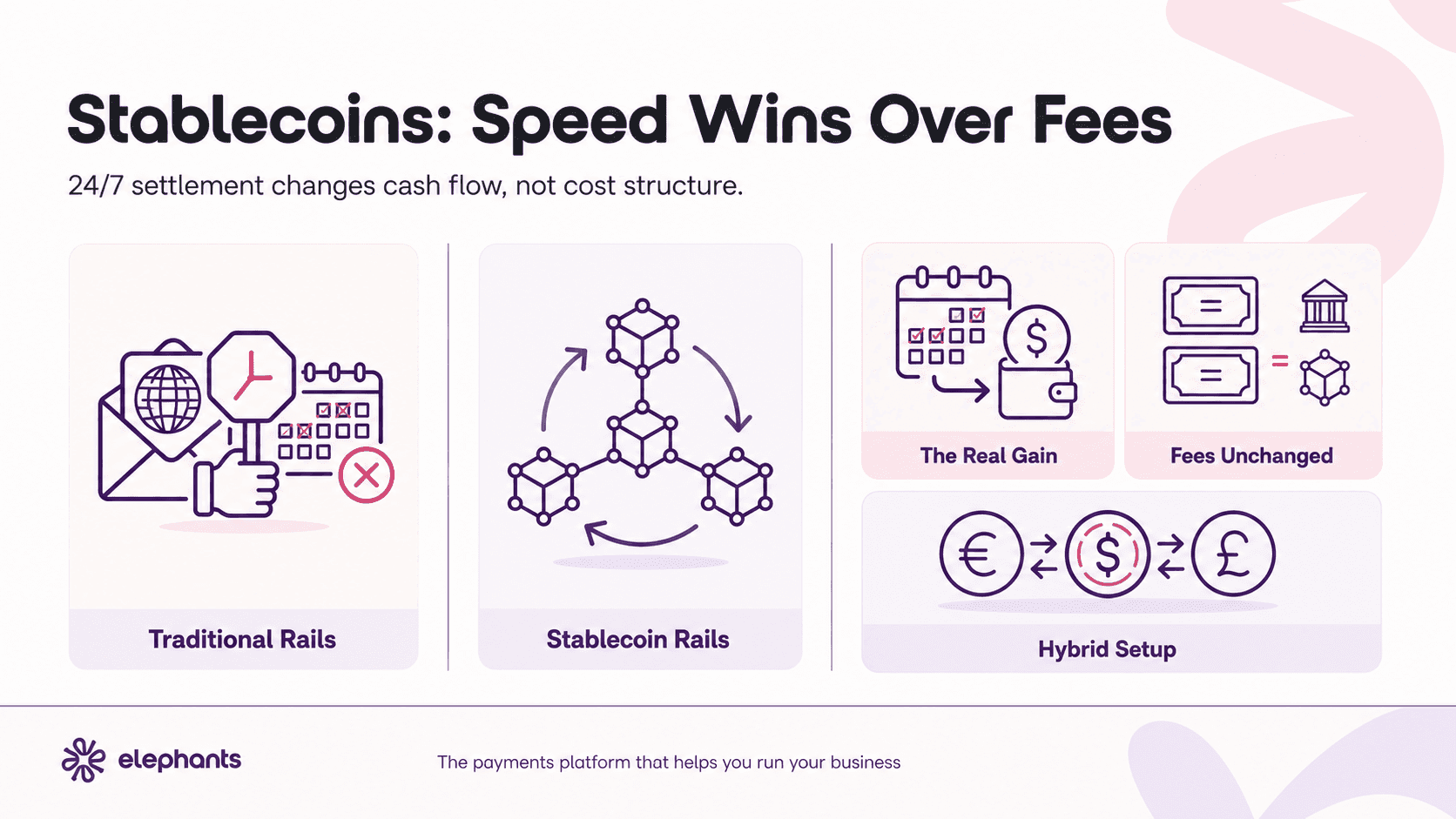
You have stock to order, a supplier who will not ship until the money lands, and a contractor waiting to start. The payment left your account days ago; it is just somewhere in between. That wait is expensive: shipments hold, work stalls, and your own cash sits in transit doing nothing. Stablecoins do not make that money cheaper to move; they make it faster by removing the clock. The real advantage of a stablecoin payment platform is that settlement continues even on weekends and holidays. For a founder, that single fact changes cash flow and supplier relationships more than any fee comparison does.
TL;DR
Stablecoin payment processing settles 24/7/365, independent of banking operation hours or settlement windows. Elephants puts stablecoin and regular rails in one place, so a payment can move on any day.
The fee structure of a cross-border payment has two components: a network fee and an FX margin. Stablecoins do not eliminate either one; what they change is when the payment can move.
The timing advantage is what matters most for founders: a payment that lands at 11 p.m. Friday instead of the following Monday or Tuesday is three to four days of working capital back in your hands.
Stablecoins work best by connecting two local payment systems, helping money move across borders faster without replacing local currencies.
Having fiat and stablecoin rails in one platform gives a business broader coverage and more control, whichever rail a given payment uses.
About the Author: Elephants Inc. helps businesses receive, spend, move, and understand money through one intelligent system. It helps businesses send cross-border payments in more than 100 currencies and serves startups, founder-led businesses, and Web3-native companies with international operations.
What does "24/7/365 settlement" actually mean for a business?
Most of the friction in cross-border payments is not in the fee. It is in the wait for settlement, the moment money actually arrives on the other side. SWIFT network timing is route-dependent: quick on major corridors, longer on complex routes. What stretches that to one, two, or three business days is institutions holding funds before releasing them, plus weekends and public holidays that do not pause your business needs.
Stablecoin settlement works differently. USDC and USDT move over blockchain networks that operate continuously, rather than only during banking operation hours. There is no batch window, no cutoff time, and no "next business day" logic. A stablecoin transfer initiated at 9 p.m. on a Friday settles in minutes, not on Monday morning. Your supplier sees the money, ships sooner, and your week keeps moving.
For a business, that gap has a direct cost. Three days of float, money that has left you but not yet reached them, on a $50,000 supplier payment is $50,000 sitting idle while a supplier waits. Across a month of payments, that is immobilized working capital, the cash you have free to actually run the business, but stuck in transit.
Do stablecoins remove the fees from international transfers?
No. This misunderstanding comes up constantly, so here is the direct answer.
Every international transfer, regardless of the rail, has the same two cost components:
A network fee. In the corridors (country-to-country payment routes) we process daily, SWIFT runs roughly $12 to $45 and local rails roughly $1 to $6. On blockchain, it is a gas fee.
An FX margin. This is the spread between the mid-market rate and the rate you actually receive. Based on the pricing we see across corridors daily, banks typically charge 2 to 3% on major currency pairs and 3.5 to 5% on exotics, while digital platforms tend to charge around 0.5% on majors and around 1% on exotics.
Stablecoins are denominated in a currency (usually USD). If your supplier receives USD stablecoins and their business runs in USD, the FX conversion is skipped entirely. That is a genuine saving. But if the stablecoin is being converted back into a local fiat currency at the receiving end, an FX margin applies at that step. The fee doesn't disappear; it simply moves to a different point in the payment journey.
Most founders aren't trying to save a few dollars on every transfer. They're trying to avoid surprises. What matters most is that you see the total cost before you send, so you can budget with confidence and there are no surprises.
Why does timing matter more than fees for most businesses?
Anyone who has refreshed a banking app on a Friday afternoon, with a supplier chasing and nothing landing yet, knows the feeling. Time is money in a literal sense when you are managing international supplier payments.
Consider a business paying an overseas contractor on a Friday. On a traditional fiat rail with a settlement hold, funds may not land until Monday or Tuesday of the following week. On a stablecoin rail, they land within minutes, any day, any hour. That is three or four extra days the contractor has access to their funds, and three or four fewer days the business carries the liability of an unpaid invoice.
This is why Elephants lets you hold both USD and stablecoins in one place. You can choose the right rail for the job without juggling multiple platforms or moving funds between accounts. Speed is only part of it: the point is to be able to receive, spend, move, and understand your money from one intelligent system, with visibility and control.
How do stablecoins connect two local payment systems?
Does every payment need to be purely in stablecoin to benefit?
No. The most practical use case for most businesses is using stablecoin as a settlement bridge between two local payouts. The sender converts fiat to USDC or USDT, the stablecoin moves in minutes across borders, and the recipient converts stablecoins to local fiat at their end. The local currencies on each side never actually cross borders. A business in Singapore paying a supplier in Mexico can send on Friday night and, in many corridors, have local currency arrive before Monday opening. Exact timing depends on the conversion step at the destination.
This matters because local rails (e.g. ACH in the US, Faster Payments in the UK, UPI in India) are fast and cheap within their networks. The problem has always been crossing the gap between two local systems. Stablecoin fills that gap without requiring either party to permanently operate in crypto.
Platforms that support this hybrid approach, as Elephants does, give a business real-time cross-border payments without asking suppliers or customers to adopt crypto natively.
What should a business look for in a stablecoin payment platform?
A stablecoin payment platform needs a few things before it is actually useful to a business.
Coverage. Can your platform actually reach the countries you pay? Stablecoin settlement is only as useful as the fiat off-ramp at the destination, the step that converts stablecoin back into local currency. A platform that supports 100+ currencies for sending gives far more practical coverage than one limited to narrow corridors.
Fiat and stablecoin in one place. A business should not need one account for stablecoins and a separate setup for USD. Being able to hold USDC/USDT and USD in a single digital wallet means you can match payments to invoices in one place instead of two.
Transparent pricing. The total cost of a transfer is the network fee plus the FX margin. Both should be visible before confirmation, not discovered after. The customer should see the send amount and the land amount with the rate locked before they confirm the transaction. No unknown deductions along the way. That is how Elephants quotes every transfer.
Integrated invoicing. If invoicing is in a separate tool, you are introducing a reconciliation gap between payment instructions and actual settlement. An ideal integrated stablecoin payment platform provides the infrastructure to reconcile invoices, so an invoice paid in USDC or USDT reconciles against the incoming payment in the same place as your fiat activity. For a business that bills in stablecoin and pays suppliers in fiat, reconciling both sides in one platform closes that gap.
Choose a properly regulated platform. A payment platform handling both fiat and stablecoin transfers should operate under a recognized regulator. Using a properly regulated payment provider helps reduce the business’s unnecessary delays while keeping your funds protected.
Elephants Inc. is powered by Elephants Growth Tech Ltd, a Money Services Business with FINTRAC (C10001690) and a Payment Service Provider with the Bank of Canada under the Retail Payment Activities Act. For businesses, this provides confidence that they're using a platform operating within established regulatory frameworks.
Frequently Asked Questions
Are stablecoin transfers free?
No. A stablecoin transfer carries a gas fee (the blockchain network cost) and, if currency conversion is involved, an FX margin. The savings come from speed and availability, not fee elimination.
Can I use stablecoins to pay suppliers who do not use crypto?
Yes, on platforms that support stablecoin-to-fiat off-ramp at the destination. The supplier receives local fiat; the stablecoin settlement happens behind the scenes.
Is USDC or USDT better for business payments?
For most businesses, the operational difference is minor. Both are USD-pegged stablecoins and both function as settlement instruments. Elephants supports both, which means you can use whichever your counterparty prefers.
What is the actual settlement time for a stablecoin cross-border payment?
Settlement on blockchain rails typically completes in minutes. The fiat conversion at the receiving end may add time depending on the local rail and institution involved.
How do I know the total cost before sending?
On a transparent platform, the cost is shown as the difference between the send amount and the land amount, with the FX rate locked before you confirm. There should be no fees deducted after confirmation. On Elephants, the rate will be shown before the customer confirms every transaction.
Does using stablecoins mean my business is holding crypto?
Not necessarily. Stablecoins can simply pass through in the middle of a payment, without your business keeping a stablecoin balance. However, holding USDC or USDT in a digital wallet alongside USD gives flexibility for future payments.
Are stablecoin payments regulated?
Regulation varies by jurisdiction. In Canada, virtual currency services (including stablecoin transfers) fall under FINTRAC's MSB framework. Businesses should use platforms operating under recognized regulators.
About Elephants Inc.
Elephants Inc. helps businesses receive, spend, move, and understand their money from one place: payments, cards, invoicing, and stablecoin support in a single platform. Elephants Inc. is a business payments platform in Canada, operating as a Money Services Business and Payment Service Provider. Elephants Inc. is powered by Elephants Growth Tech Ltd, a Money Services Business with FINTRAC (C10001690) and a Payment Service Provider with the Bank of Canada under the Retail Payment Activities Act. This enables Elephants to support foreign exchange, money transfer, virtual currency services, payment accounts, fund holding, and electronic fund transfers for end users.
Funds held on the platform are safeguarded client funds under the Retail Payment Activities Act. Account balances are not deposits and are not covered by Canada Deposit Insurance Corporation (CDIC) or any other deposit guarantee or investor protection scheme. Virtual Assets are not legal tender and are not regulated in the same manner as fiat currency.
Elephants facilitates bulk payment transfers only and is not a licensed payroll or employer of record service. Customers retain full responsibility for their employment and tax obligations.
See current plans and pricing at https://elephants.inc/
Whether you're paying suppliers, collecting payments, or managing business spending, Elephants helps you receive, spend, move, and understand money through one intelligent system. Visit elephants.inc to learn more.
References
Read More


